Showing posts with label Lucknow. Show all posts

Monday, July 7, 2014

Monumental Meanings: The Nawabs' Lucknow Vs. Mayawati's Lucknow

Adaab everyone! *Adaab is a greeting in Urdu that literally means respect.*

I have a lot of pictures I want to show you and stories to tell in this post. So much is happening! This post will mainly focus on some of the incredible places I've seen, and the photos will be interspersed with facts and anecdotes, and occasionally some rants. 

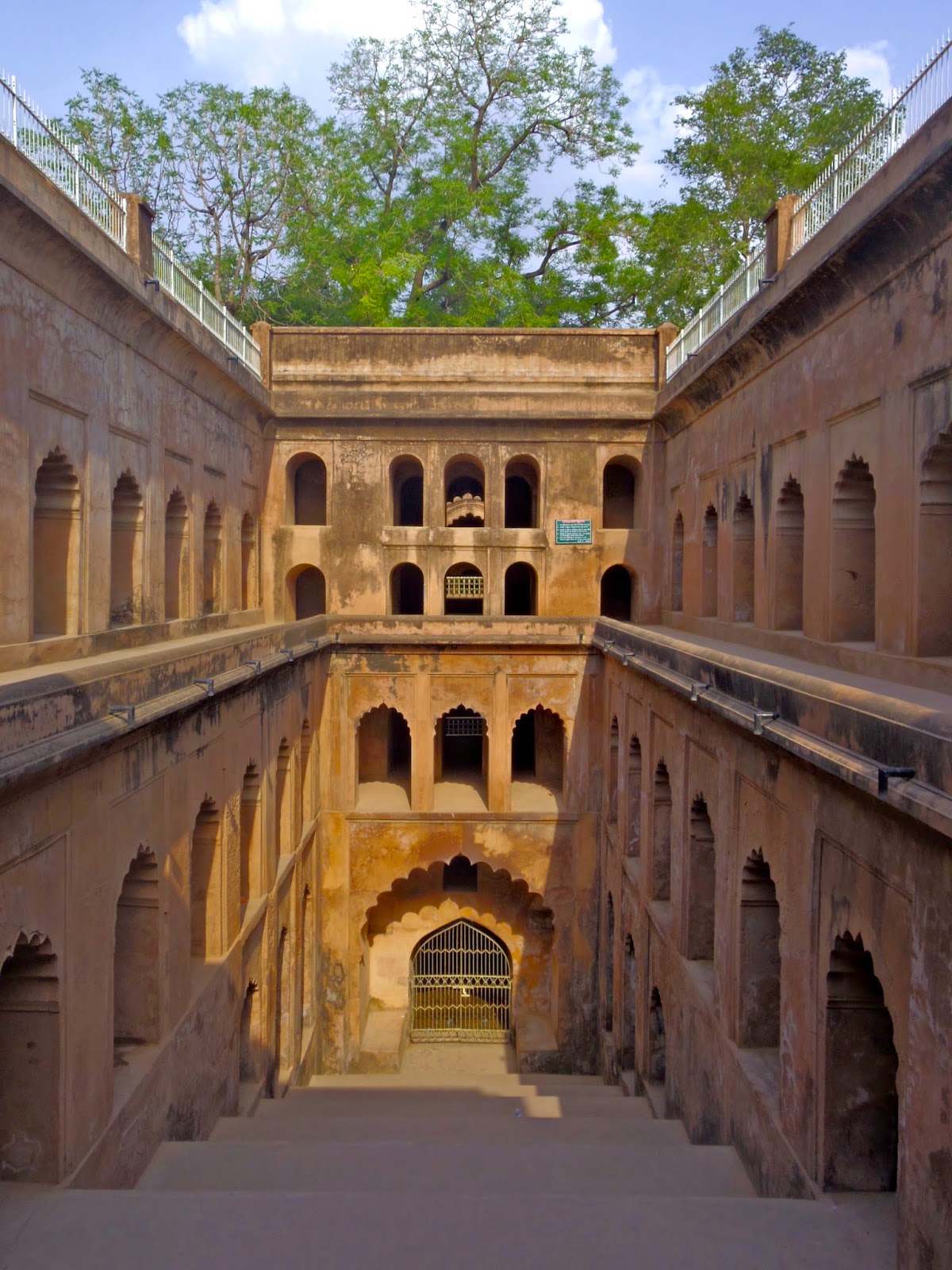
Over a week ago we went to the imambaras (it is so crazy to think that was more than a week ago - feels simultaneously as if it has been longer and shorter than that!). Imambaras are huge beautiful shrines built by Shi'as. Lucknow is famous for its two imambaras, common pilgrimage sites for shi'a Muslims in the region. The Bara Imambara (big imambara) was completed in 1784 by Asaf-ud-Daula, the Nawab (ruler) of Lucknow at the time. The architect was apparently a relative of the architect for the taj mahal and there certainly is a mughal flavor to the architecture. On the bara imambara complex there is also a huge mosque, which only Muslims could enter to use for prayer. There is also a large gate called the Rumi Darwaza. Darwaza is the Urdu word for the door. I think it's such an elegant word for door!


When you enter into the Bara Imambara you have to take off your shoes and climb up 45 stairs, which feel like a lot more on a hot Indian summer afternoon. Inside the stone walkways, though, the ground is cool and the dimensions and light are mezmerizing.


However, up on the rooftop your soles will burn. The quick dash across smoldering stone is totally worth it though for the view, looking over the Bara Imambara complex down to the Gomti River that ambles through Lucknow.


Inside the Bara Imambara is a great architectural mystery which has made this place a potential nominee for the UNESCO World Heritage Site certification. The great hall in the center of the building has no wood, metal, or stone beams to support it. On top of that, rows of glass candelabras hang from the ceiling. 

 
 The Bara Imambara is famous for its bhulbhulayah (labyrinth in Urdu). It's a building that functions as a 3-dimensional labyrinth, with passages interconnecting with each other through 489 identical doorways. Apparently there was a pond at the bottom which only someone positioned in the labyrinth could see, so someone at the center of the labyrinth could see when someone was at the entrance but the person entering could not. Isn't that cool?
Isn't it great to be a foreigner? See price below:


Then there is the Chota Imambara. This imambara is smaller but much more ornamented and beautiful in an entirely different way than the Bara Imambara. It was built by Muhammad Ali Shah, the third Nawab of Awadh (the state that Lucknow was the capital of before independence), in 1838.


The complex has beautiful gardens and ponds, and the style of buildings seems to me more European than Mughal, but with that touch of bright Indian color. 


When you enter into the Chota Imambara, the bright purple ceiling is filled with beautiful glass chandeliers of all shapes and colors and sizes.


The imambaras struck me as so beautiful and so alive, as a place of spiritual renewal and recent history. It was also very interesting to see the differences in aesthetic qualities and architectural styles from one nawab to the next, merely around half a century apart. One was mughal and regal and had the warm abrasive quality and detail of an old man's suntanned wrinkled cheeks. The other was smaller but bursting with color and ornamentation, as bejeweled and happy as a wedding party. I would definitely go back before I leave Lucknow.

A week later I went to another complex of monuments in Lucknow, these only completed in 2009. Ambedkar Park was the massive project of Mayawati, former Chief Minister for Uttar Pradesh, the state for which Lucknow is the capital. Uttar Pradesh happens to be the most populous state in India, and simultaneously one of the poorest. The Memorial Park happens to be located in the neighborhood in which I am living for the summer, Gomti Nagar, which I found out is the largest planned residential colony in India. The Park controversially cost over 7 million rupees to construct and its entirely built with red sandstone brought over from the state of Rajasthan way in the North West of India!

The park costs 10 rupees to enter (about 15 US cents), and once you enter through the second gate and into the complex, you feel like you left Lucknow and are now in a new world of silence, cool breezes, emptiness, and smooth earth-colored stone. It is a very peculiar space indeed.


Inside the buildings you will find larger than life statues. Below you see a statue of Mayawati - and how much larger it is than the average person. Self-aggrandizement or a rare Indian giant?


Mayawati's political symbol is the elephant so you will see elephant statues everywhere!


Inside, large statues of important community members, revolutionaries, and contributors to Indian politics tower over napping locals taking respite in the shade as the afternoon haze sets in.


It was amazing to see beautiful carvings and monuments that seemed like something I would find in an archaeological park or centuries-old tourist destination. This memorial park is only 5 years old! 


My tour guide through this place was my ever patient and friendly zabaan dost (language partner). She is a local university student and so helpful with my Urdu. I spent four hours with her last week, speaking Urdu almost non-stop, and we actually understood each other and were actually having conversations about our families and movies and what I think of India and Urdu - IN URDU! I really feel like we are becoming friends. She gets added praise for exploring hot hazy Lucknow with me during ramadan, as she fasts from sunrise to sunset with not even a drop of water to sustain her. That strength of faith is admirable!


However, at one point the heat became too much so we found a random dude in all that emptiness who took us to a water pump, so she could at least cool down her face and feet.


She is so friendly that we also struck up a conversation with this security guard, Gulam Rasul, who was very curious why an Indian girl was showing around this camera-toting blonde girl during the hottest part of the day. He ended up giving us his number in case we want a free ticket in next time. My language partner told me that this is what real Indian people do: they help each other out and are incredibly friendly.


As we left I posed under some hindi lettering that I didn't understand but that my language partner thought looked really pretty. I was feeling pretty happy to leave this strange, desolate place and return to the colorful, chaotic India I have gotten to know in the past weeks.


It really saddened me to see such a huge place, worth so much money, practically empty in the most populous state in India. To think of all that building material, all those abodes, standing empty and silent, devoid of  life and death and the circles that keep us going, while millions of people in this state are either homeless or live in shacks and can only dream of a stone-supported home. Who does such a monument benefit? The archaeologists who try to understand its meaning centuries into the future? The locals who seek out a rock-hard 10-rupee napping spot in the summer heat? I had difficulty seeing the point of it, since when I was there it seemed to be too large and stark of a space to nurse the intimacy of life. Then again, in a crowded and dirty place like India, clean stone and a lack of people are probably a huge relief. Nonetheless the cost of this building project, in my opinion, far outweigh the pros. What do you think?

Later this week I will try to post about my visit to a sufi shrine and mango grove, and a review of the hotel we stayed in to celebrate the 4th of July. Hopefully I'll have it posted before Friday, but it's a busy week! On Wednesday I'm going to visit a local NGO as part of the program, on Thursday my language partner is taking me to the science center in town, and on Friday I fly off to MUMBAI for the weekend. So excited for everything, but especially Mumbai!

Khuda hafiz for now!

Wednesday, July 2, 2014

Life in Lucknow

A lot of you might be thinking that I must have encountered culture shock or the infamous Delhi Belly or some other sort of extreme experience of adjustment since I got here. But it really is remarkable how quickly the human mind and body can adapt to a new place. Things that caught my attention when I first got here, like stray goats and dogs and monkeys and cows on the road, people peeing and showering outside in clear sight of the street, incessant staring wherever I go, and the mixture of thrill and caution when riding a rickshaw, as well as many other things, have simply become facts of my new life here in Lucknow. And there are many beautiful aspects too. Stunning imambaras with beautiful Indo-Islamic architecture, the bright colors of people's saris and kurtas, the sound of drums down a street lined with mango wallahs, the delicious smell of spices rising up from food stalls and out of kitchens... I am not immune or indifferent to these details, but I am definitely more intrigued than shocked. It is the country of contrasts that I had always imagined it would be. It often strikes me as a mixture of my memories of Cambodia and of Jordan, as well as of a flavor all its own, with a heady scent of fruit, spice, and sweat.

It has been so busy since I got here and I have so much I want to show you! Here are some photos of life in Lucknow and accompanying explanations, with a poem thrown in. 

Here is the outside of the institute, where we take our Urdu classes.

They have flung me into the deep dark waters of advanced Urdu, but in such an intensive program, I feel that this is the level where I will learn the most. Although I spend more like 4-6 hrs on average on homework, rather than the 2 hours they suggest, it is extremely gratifying to already be able to hold basic conversations in a language I had never formally studied before merely a week and a half ago.


Today I tried to speak Arabic and I was already mixing it up with Urdu! This prompted me to write a poem about the mixture of frustration, excitement, and confusion with learning a new language and in the process forgetting the one you previously learned. 

Tongues and lips
Blink and flutter
With new values
Of another world I sink into
Like a sea of someone else's memories

My pen is my sword
In the battle against my childhood logic
Of languages I once thought I knew

For to remember something new
You need to let go of everything
And recognize that with each memory lost
You grew.


All my classes are very small and individualized and run from 9am to 1pm every day. In most of my classes it is just me and one other girl, who also has a background in Arabic, and in other classes we aren't more than 4 people. All the teachers are so kind and helpful, and encourage us to learn from our mistakes rather than feel ashamed of them. Chai in the morning, late-morning, and afternoon, as well as lunch with fresh mango often offered as dessert, help keep our minds alert throughout the day. I'm so happy to finally be in the land of chai and mangoes, two of my favorite things in the world!Every Wednesday a monolingual speaker comes to speak to the intermediate and advanced level students. Last week a descendant of the Nawabs for which Lucknow is famous visited us to speak about the history of Awadh, what this region was called before independence. It was especially exciting to meet him since he was featured in the documentary about Lucknow that we are watching in listening comprehension class. Apparently he is a bit of a local celebrity!


After class we either have a cultural class (I do cooking on Mondays and will post a recipe in another blog post), meet with our language partner (I'm paired up with a really sweet and patient 19-year old Muslim girl named Nusrat), explore (which can mean finding the perfect chikan dupatta shop or stumbling upon the crumbling British Residency), or finally making our way home with the trusty old yellow and green auto-rickshaws. Along the way, mountains of mangoes piled high by street salesmen have become a common sight, as well as baby monkeys eating stolen mangoes (they are so cute!).


It isn't strange to see cattle in the middle of the road. These urbanite cows chewing on trash in over 40 degrees Celsius would probably envy the Swedish cows I grew up near, who munch on lush green grass in cool, silent pastures.


Outside our house there is a beautiful little garden with a swing. They water it every day and yet the grass still gets too dry - that is how hot it is right now!


Meet John, my host family's parrot. He sits outside of my shower window and once in a while says "Kya hua?" (What happened?) or "Hello!" in between squawking. It is so funny!


During one of my first days here I headed to the old part of Lucknow, called Aminabad, to buy some cheap kurtas. You wear kurtas either with pajama type pants or leggings, and you can get them for less than $2 in any print or design, including one that can match your macbook computer!


These are some of the lovely ladies I traveled to Aminabad with. They are just a small selection of the amazingly caring, friendly, goal-oriented and easy-going people I've met thanks to this program.


 Apparently our visit to Aminabad only skimmed the surface of the place, but it was beautiful nonetheless in my eyes. 


Aminabad is where you are most likely to see Urdu signs, which are otherwise rare in Lucknow (and India in general). I caught a photo of one below though! Urdu is the third and lowest script you see. 


And alas wherever we go we attract a LOT of stares. Here staring wasn't enough -- we were caught on film! I love how the two rickshaw drivers on either side are also staring at us. It can be unsettling at first, but after experience with this sort of attention in the mediterranean and the Middle East, the Indian reaction to my pale skin and blonde hair doesn't come as a surprise.


I will have to share photos of the imambaras we visited last Thursday later this week. I will also have more posts after this weekend, since I am going to Ambedkar Park on Friday with meri zabaan dost (my language partner) and a field trip on Saturday that will take us to a shrine and a mango orchard, which I will also want to post about. Until then, khuda hafiz!

Friday, June 27, 2014

Coming home to the foreign

I wrote the following post last Monday but haven’t been able to post it yet for a number of reasons (lack of wifi, classes and lots of stuff to keep me busy – classes, shopping adventures, Indian food, my shower, my bed, my homework, etc.). I will intersperse this post with updates in italics and will definitely post some new pictures as soon as I have a chance to upload them to my computer. ENJOY!

One of my favorite feelings in the world is being immersed in a completely unfamiliar place, feeling the thrill of the exotic tease all my senses as I am challenged to transform the foreign into the familiar. Am I strange? I guess it’s a symptom of my travel addiction.

I am in India.

This thought runs through my head a lot ever since I got here. I am writing this at a small wooden desk, in a swelteringly humid bedroom with floor-to-ceiling windows looking out onto a garden, walled in by stone and crimson bougainvillea. Hair is sticking to my neck as I rub a sleepless night of unfamiliar heat out of my eyes and I can hear the parrot cackle outside, along with the cacophony of morning birds. I am in India. It was only that hot because I hadn't yet figured out how the fan and air conditioning worked. Now my room is so cool I've got a cold!

As we only have internet at the institute, I will post it there, after having even more experiences and lessons learned. Today is my placement test, to prove that I’m truly a beginner in Urdu. PLOT TWIST: First they put me in Intermediate, and today I was promoted to Low Advanced. We are already reading newspapers and magazine articles! Before that I will have breakfast with my host family and the two program companions who live here with me, I will have my first ride in a rickshaw (overrated), and go through a State Department Briefing via skype.

Here are a few photos I’ve been wanting to post of my journey so far!

Part 1: WHAT TO DO WITH A SIX-HOUR LAYOVER IN FRANKFURT

Our program had conveniently booked a 6-hour layover in the very international airport closest to my long-distance love. I was certainly not going to spend this layover in the airport (as if I ever spend long layovers in the airport haha – layovers have allowed me to discover Istanbul, Bucharest, and Iceland).

We took the train to Frankfurt am Main Haupbtbahnhof to start our little stroll around the tiny piece of Germany we had time to visit. After a short walk we stopped for some pretzels  and pastries, and the very german apfelschorle (apple juice mixed with seltzer water).


We then stopped by the Euro sign, where no one could deny that we were in Europe. There was even a gift shop where you could spend your euros on collectible euros.


The pinnacle of our trip was the ascent to the top of the Main Tower, with an elevator taking you up 54 floors to a maginificent view of the city of Frankfurt and the surrounding dark green countryside, with the Rhine river running through it.


I was ecstatic to be with mera pyaar and we took the opportunity to take lots of photos before our next episode of long-distance.


Back at the airport, four of us program participants had a final meal of good asian wok before our next 2 months of Indian food. I highly recommend this place if you’re ever stuck in Frankfurt Airport and really hungry!


Part 2: LOVE AT FIRST SIGHT: FIRST IMPRESSIONS OF INDIA

We arrived in Delhi just passed midnight, jetlagged after two uncomfortable overnight flights across over 9 timezones. From the moment we stepped off the plane, we were attracting stares. As we piled into our air-conditioned minibuses who would take us through the warm Delhi night to our hotel, I could see old men looking down at us as if we were in a gladiator ring, fighting culture shock. I was just so excited to be in a place I had dreamt of for years!


We stayed at the Ibis hotel, which already had breakfast ready when we arrived around 2am. I relished the free wifi and a room to myself with a bed to stretch out on for three hours before my third and final flight to Lucknow. Those three hours were so refreshing after so much sleeplessness on airplanes!  The breakfast was really good too, and I had my first sip of chai in India, as well as my first taste of what Indian breakfast is like.

We nearly missed our flight to Lucknow because our minibus driver took a wrong turn on his way to the airport. At the small domestic terminal we seemed to be the only non-Indians, and due to the tight schedule we were rushed through security, overweight fines quickly handled by the program. The brief 45-minute flight to Lucknow was so nice after the 7 or 8-hour flights of the past couple of days, especially in the company of all my fun and easygoing program participants. However, the haze we encountered in Delhi seemed to stretch across the entire distance we flew, making my window seat not as exciting as I had anticipated.


As we drove to our hotel in Lucknow, the small and elegant La Place Sarovar Portico, I just wanted to get out and explore Lucknow with my camera. But after lunch at the hotel I was already so sleepy, and decided to take a half-hour nap, which swiftly turned into two hours. Fortunately I still had time to explore some of Hazratganj, the famous street at the heart of Lucknow, before dinner. Here are some of my first impressions captured through my camera lens:


After dinner I watched dramatic love stories, Tamil movies with English subtitles, and Little Krishna 3 on the hotel room TV before falling into comfortable sleep in the air-conditioned room.

The next day our orientation started, where we met our program instructors, introduced ourseleves as best as we could in Urdu, were given cellphones, and gradually siphoned off to our host families. I was in the fourth group to leave to my host family, the Khan family living in the most modern and trendy part of Lucknow, Gomti Nagar. I would share the host family with two other program participants, Sabrina and Yasin, who are sure to become good friends over the course of the program.

In the car to the host family I saw cows in the middle of the road and monkeys climbing bridges, as well as shacks by putrid gutters juxtaposed with huge beautiful houses with mughal architectural elements. This was the India I had heard so much about, right in front of me.

My host family live in one of those big beautiful white houses with a garden and terrace and servants and jovial auntyji welcoming us into her cool, airconditioned sitting room with glasses of cold water. It felt like I had stepped into an oasis – I couldn’t believe this was my home for the next two months.

I have a host mother, who I call auntyji, as well as two host siblings living here. My host sister wants to be a photographer and has already been a tremendous resource on where to go in Lucknow. My host brother, who hasn’t really engaged with us so far, just came back from studies in London. Auntyji says all her children were educated in either Oxford or Kings College and she has family all over the USA and Europe. The host family in general seems well-traveled and well-educated, but most importantly, so caring of the students they host, of which they seem to have a lot of experience. My host mother clearly understands all our English but mainly answers us in Urdu – with that sort of support I feel like I’ll learn the language in no time!

Here are some photos of my room and ensuite bathroom

My bed! <3

View out my window!

My bathroom

In the afternoon we sat and chatted with auntyji in the TV room. The rest of the afternoon was unplanned so Sabrina, Yasin, and I chose to watch a movie. Just as we were ready to press play a strong breeze brushed through the courtyard and into the house. Thunder rolled in and soon the skies opened up – the monsoon was here! We watched in awe at the rain pelting down. We hadn’t expected the monsoon to come for another week! Apparently the monsoon gives some preview rain showers before it actually hits. It is getting hotter by the day and the 5-minute rain that comes once in a while does little to curb the heat. Oh well.

At dinner auntyji and the cook made us a very lightly-spiced dish of tofu (she had read in a magazine that Americans liked tofu), chapatti/roti with cheese, potatoes, corn, and shedded cucumber in custard. It was actually very good but we told her we are ready to handle Indian spice if she wants to give it to us. We finished the meal with my first taste of Indian mango – absolutely delicious, confirming that aam (the Urdu/Hindi name for mango) is still my favorite fruit.


At the dinner table we talked about Lucknow and Bollywood. We were all tired though and soon went off to bed. I took a nice cold shower before bed, although it did little to help the sticky heat of the night, as the electricity had gone out earlier that afternoon and still hasn’t returned this morning. Welcome to India!

I hope you enjoyed the blog post. I'm so happy I finally got to post it! Next posts will showcase photos taken on the roads of Lucknow, that are run in total chaos by cows, mangos, and motorcycles mostly (the monkeys dominate the bridges), my shopping excursions, and my trip to the Bara Imambara and Chota Imambara (shi'a shrines in Lucknow). I will also be doing more exploring of Lucknow this weekend and will certainly have pictures and stories about that to post as well. In other news my classes are super challenging, but my teachers and fellow students are all amazing and in this environment I am learning so much! 

Khuda hafiz!


Saturday, May 24, 2014

India: How and Why?

What is happiness?

How do you define happiness? Maybe it is getting an email from the US State Department that you have been awarded the highly selective Critical Language Scholarship to study Urdu in the distant country of India. YES I'M EXCITED!

What is the Critical Language Scholarship?


Let me explain what the Critical Language Scholarship is. It is a US State Department-administered program that offers intensive summer language institutes for 13 languages in countries in which they are spoken. By administered, I mean that the State Department covers airfare, accommodation with host families, tuition cost at the institute (which can be transferred as college credit issued by Ohio University), a stipend for added transportation and living costs, meals, field trips to local sites, etc. In return, scholarship recipients are to dedicate themselves to continue learning this language after the program ends and use it in their future career (which the State Department obviously hopes will be in their service). The main criteria is that you have to be a full-time student at a US institution of higher education. Since I am moving to London in the fall to start at LSE, this was my very last chance to apply to this program! This year they got 5,500 applications, of which only around 550 students were selected - a 10% acceptance rate! We will be 35 students studying Urdu, ranging from beginner to advanced, and with all sorts of academic and personal backgrounds and professional goals. I can't wait to meet my fellow program participants!

Why study Urdu?

Many have asked me why Urdu (and also what is Urdu, which I will cover in a bit). After all, I've been studying Arabic for the past three years - why didn't I apply for the Arabic language institute offered? I've actually been fascinated by South Asia before the Middle East captured my interest. India and Pakistan caught my imagination both as a child and a young adult as a place of beauty, complexity, extremity, and emotion. Here is an (edited) excerpt from my application essay:


The confluence of water politics, unresolved border tensions, and cultural diversity draw me to the Urdu-speaking regions of South Asia. Suzanne Fisher Staples’ acclaimed children’s books set in Lahore and the Cholistan desert and the enchanting language of the great Urdu poets, such as Muhammad Iqbal and Meer Taqi Meer, had introduced me to the religious realities and gender debates of the region early on, but it was through my study of the Kashmir region that my burgeoning interest blossomed. My first in-depth paper in high school focused on Kashmir, and my position at the first Model UN conference I staffed in college focused on Kashmir and India-Pakistan relations. When I later learned about the water aquifers underneath the disputed territory of the West Bank, I recognized that, like Kashmir, water was an implicit source of political conflict. My long-standing passion for the culture and politics of Pakistan and India could finally be connected with my academic focus in Arabic and the Middle East through the topic of transborder grassroots solutions to the life-threatening issue of water scarcity. The advanced proficiency I achieved in Arabic during my time at the George Washington University and in Jordan will help me learn to read and write Urdu nastaliq script. However, my interest in the region warrants deeper research that requires a more formal study of the language.


You may also know that I have a Pakistani boyfriend and think that I am studying Urdu only because of my relationship. He would not let me pursue the study of Urdu if it was only for him. Although he has helped introduce me to the language and the culture of the subcontinent, my pursuit of the language is based on a passion to understand more about a part of the world so often misunderstood - similar to my inclinations to explore the Middle East.

What is Urdu?

Urdu is historically associated with the Muslim population of the Indian subcontinent and has an extensive literary heritage in the region. It emerged as a "camp" language of the Mughals, who blended their Arabo-Persian linguistic origins with the Sanskrit languages native to the Indian subcontinent. Urdu is still perceived in the region as a language of sophistication and poetry.

Centuries-old Urdu satire found at the Metropolitan Museum of Art in New York City
As I mention, Arabic will help me master the alphabet faster since the script is very similar and several Urdu words are taken from Arabic. However, conversationally Urdu is nearly identical to Hindi. It will be a quite a change from Arabic, for which reading and writing can generally be understood by all Arabic speakers but speech is highly localized, with dialects possessing very different grammar and vocabulary than the written Arabic. Urdu, in contrast, can only really be read and understood by other Urdu speakers, while spoken Urdu can be understood by the millions of people who speak Hindi. I am very fascinated by the similarities and contrasts between Arabic and Urdu, and consequently the interrelationship between South Asia and the Middle East. 

Why study Urdu in India?

Urdu is the national language of Pakistan. Then why would we study Urdu in India? Urdu is the language affiliated with the Muslim minority in India, and has over 50 million speakers in the country. It is an official language of six states, of which Uttar Pradesh, the state I will be in, has the most speakers (numbering more than 13 million). Lucknow, the capital of Uttar Pradesh, has a substantial Muslim shi'a minority, since there are significant shi'a shrines in the city. I will write a post at a later point about the history, demographics, and geography of Lucknow. We will be studying at the American Institute for Indian Studies in Lucknow, which has been hosting American university students to study India through its diverse languages since the 1960s.

This is where you will find Lucknow
In the next few weeks I have a few planned posts, including a more extensive profile of Lucknow, a list of things I am packing for India that I have heard are essential, and a list of books on Urdu language and culture that I am reading or plan to read. But now I need to go to bed!

Shab bekhair (good night in Urdu)!